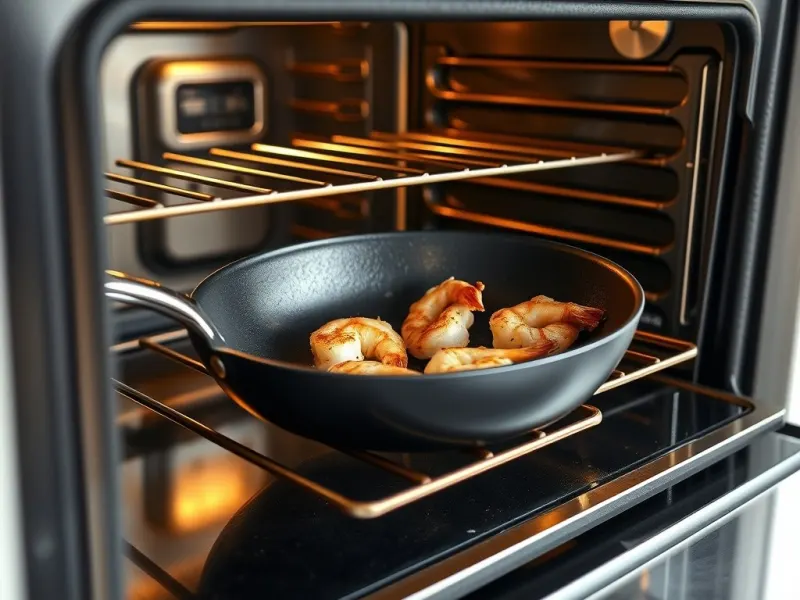
Most people brace for the coating the moment a nonstick pan heads for the oven. They picture Teflon melting into dinner.
Yes, you can put a nonstick pan in the oven, and the coating usually survives just fine. The handle is what actually fails, and it happens more often than most cooks expect.
Our nonstick cookware buying guide covers the rest of the buying decision, from coating chemistry to induction compatibility.
We researched why this specific mistake keeps happening, and it almost never comes down to the surface everyone worries about.
The Handle Is the Weak Link, Not the Coating#
The classic version of this mishap goes the same way almost every time. A frittata cooks on the stovetop, then goes into a 425°F oven to set the top. A few minutes in, the handle feels soft to the touch.
Not melted, just wrong in a way a handle should never feel. It cools into a slight warp.
PTFE coating has a 500°F safe-use ceiling, which is still above what most oven-finishing recipes need. What actually fails first is almost always the handle material, not the surface everyone assumes is the risk.
Bakelite is the usual culprit. It feels sturdy on the stovetop, where it stays relatively cool, but a 425°F oven surrounds it with radiant heat from every direction that the stovetop never applies. That difference, radiant heat from every side instead of contact heat from below, is why a handle that has handled the stovetop for years can still fail the first time it goes in an oven. The material sets the real ceiling, and it has nothing to do with the coating.
What Actually Happens When a Nonstick Pan Overheats#
A warped handle on its own is a mechanical failure, not a chemical one. The plastic or rubber softens, cracks, or bends, and nothing hazardous escapes into the kitchen air in the process.
The coating can release fumes as low as 500°F, but human polymer fume fever generally begins much higher. NCBI's Polymer Fume Fever review places human symptom onset at 662°F and pyrolysis at 752°F. A separate case-report review describes polymer fume fever, first reported in 1951, as ranging from mild flu-like symptoms to pulmonary edema, pneumonitis, and death in severe documented cases. Birds are a different case: according to veterinary poison-control guidance, birds have an unusually efficient respiratory system that makes them far more sensitive to inhaled toxins than people, cases have been reported even when the bird was not in the same room as the pan, and poisoning has occurred at recommended cooking temperatures.
Households with birds should treat any PTFE cookware use with more caution than the temperature thresholds below suggest, since the risk threshold for birds does not track the human off-gassing range described above. Keeping birds out of the kitchen while cooking is the safer default.
Put plainly: the risk most cooks will actually run into is a ruined handle, not polymer fume fever. Human symptom thresholds sit above normal baking and roasting, while broilers and self-clean cycles are outside the normal-use zone for nonstick cookware. The habit worth building is checking the handle before the oven, then keeping nonstick away from broilers altogether.
Nonstick Pan Oven-Safe Temperature by Handle Type#
A pan's coating and body might list a high oven rating, but the weakest component always sets the real ceiling.
Stainless steel handles. Solid metal handles remove the plastic weak point. These are the pans built for stovetop-to-oven cooking, but the brand's listed oven rating still controls because the coating, rivets, and lid may have their own limits.
Silicone-wrapped handles. Manufacturer heat-resistance specs for cookware-grade silicone are commonly rated up to 400°F. Some sleeves are removable, which creates an option: pull the sleeve, use the bare metal handle with an oven mitt.
Bakelite and hard plastic handles. 350°F is the common ceiling, and cookware lines built around Bakelite grips, like Ekco's Evolution line, are explicitly rated oven-safe to that number. A hard, opaque handle that feels like dense plastic is almost always Bakelite; assume 350°F unless the manufacturer states otherwise.
Wooden handles. Not oven safe at any temperature. They stay on the stovetop.
How to Check If You Can Put a Nonstick Pan in the Oven#
We start by flipping the pan over. Some manufacturers stamp an oven-safe symbol on the bottom, often with a maximum temperature printed below it. If it is there, trust it.
If there is no symbol, we look for a model number stamped into the base or printed on the handle, then search that model number on the manufacturer's website. Almost every brand publishes oven-safe ratings in its product specs. The customer service line works too, and most brands can confirm a rating quickly once given the model number, even without the original packaging.
If neither route gives a clear answer, we do not guess. We treat the pan as stovetop only. Replacing a handle is never worth the risk of one frittata.
What to Do Differently After the First Mistake#
The instinct after a warped handle is obvious: reach for cast iron or stainless steel for anything going in the oven. Both are solid metal with no plastic to worry about, which solves the heat-tolerance problem entirely.
The gap that opens up is food release. Cast iron and stainless are not nonstick. Cast iron handles a frittata fine once it is well buttered and the edges get a moment to release, but delicate egg dishes, fish that falls apart when pried, or a Dutch baby that needs to drop cleanly all still call for nonstick.
Most nonstick pans, though, ship with plastic handles that cannot go in the oven at all. That is the real dilemma: choosing between oven tolerance and food release every time a recipe asks for both.
That tension gets sharper on a glass-top stove, where dragging a heavy cast iron skillet around already calls for caution.
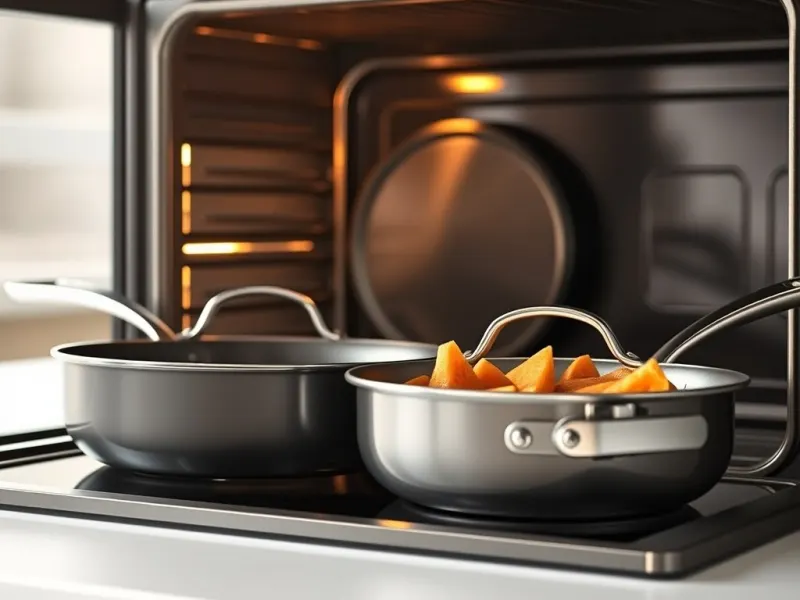
The fix is a nonstick pan built entirely without plastic handles. That narrows the field fast, since most budget-tier nonstick pans use plastic handles because they cost less to manufacture. We look for three things:
- No plastic anywhere on the pan
- An oven rating of at least 450°F
- A price that makes sense for something that eventually gets replaced, since all nonstick coatings are consumable
A 12-inch pan is the right size for a frittata or shakshuka that feeds two.
The Anolon X fits that checklist closely. Anolon's own specs rate it for oven use up to 500°F, with an all-metal build and no rubber components at the rivets. Its SearTech surface is built around a stainless steel mesh that keeps oil centered under food, which Anolon markets as a searing advantage over a standard nonstick surface.
Longer-term coating durability is still less established. SearTech is a newer construction than a standard flat PTFE surface, so we would not buy it expecting better coating life. If the pan only goes in the oven once or twice a month and a warped plastic handle is not a recurring problem, a budget T-fal with a silicone handle rated to 400°F is the cheaper solve.
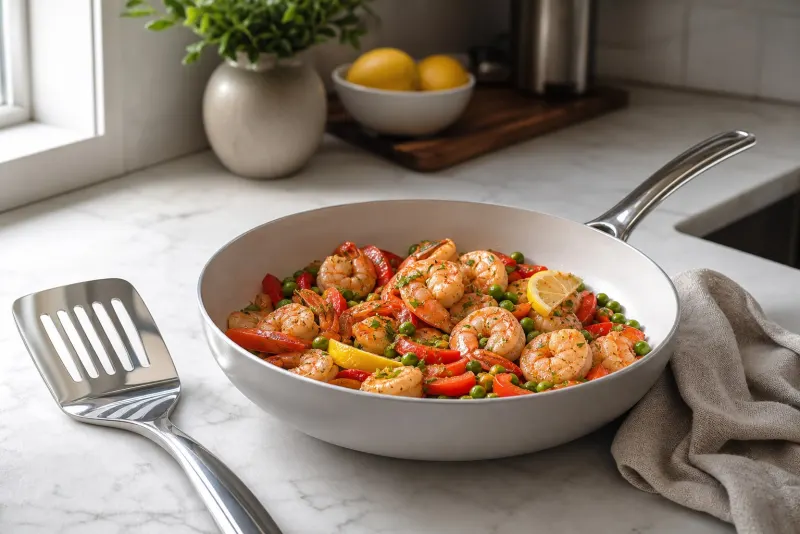
The other option worth mentioning is the GreenPan Valencia Pro, a ceramic-coated pan with fully metal handles for cooks who want to avoid PTFE specifically. GreenPan rates the pan body for oven use up to 600°F with stainless handles. The tempered glass lid that ships with some sets carries its own, lower rating of 425°F, so the lid becomes the real ceiling the moment it goes on the pan.
Ceramic coatings wear faster than PTFE under daily use, which is the central trade-off with this pan. That makes it the shorter-lived choice, so this is the pick only for cooks who specifically want to avoid PTFE and accept faster coating wear to get it. Whether that trade is worth it depends on how much the PTFE question matters. You can look up a brand's PFAS status in our cookware safety checker, which quotes the source for every verdict it shows.
Three Rules for Using Nonstick Pans in the Oven Safely#
Check the handle before the coating. If the handle is plastic of any kind, the pan stays on the stovetop regardless of what the coating can tolerate. This one rule prevents the most common warped-handle mistake.
Never put a nonstick pan under the broiler. A broiler points direct radiant heat downward onto the pan, pushing the handle and coating far beyond any manufacturer's stated oven-safe rating within minutes. The combination of handle destruction and approaching PTFE decomposition temperatures makes it a hard no for any nonstick pan, PTFE or ceramic. We recommend cast iron or stainless steel for broiling instead, or the material selector quiz for a quick personalized recommendation.
Never run a self-cleaning cycle with a nonstick pan left inside. A pyrolytic self-clean cycle heats the cavity to roughly 880°F, far past the highest heat any broiler or recipe reaches. A pan forgotten inside will lose both its coating and its handle, and it will need immediate kitchen ventilation afterward.
Want the full breakdown of how we cross-check manufacturer specs against real-world failure reports before publishing a verdict like this? Our review methodology covers the process end to end.
What to Do If You Suspect Off-Gassing Happened#
If a pan was left empty on high heat, forgotten under a broiler, or run through a self-cleaning cycle by mistake, the response is the same regardless of which mistake caused it. Ventilate first: open windows, run the exhaust fan, and move people and pets to another room until the air clears.
Do not try to salvage the pan. A coating that has decomposed once is chemically compromised, not just cosmetically scuffed, and there is no way to tell from the outside how much of the surface reacted. Replace it rather than testing whether it still "works fine."
If the mistake happened with food already in the pan mid-recipe rather than an empty pan on high, there is nothing to inspect. Human polymer-fume-fever thresholds sit above normal cooking temperatures, so a frittata or shakshuka that finished in the oven was never in that scenario to begin with.